
Accounting for Foreign-Owned US LLCs | Practical Bookkeeping Explained
Running a US LLC with a non-US owner should not make bookkeeping difficult. Learn why most providers hesitate, where the real issues arise, and how proper accounting structure solves the problem.
INTERNATIONAL AND CROSS-BORDER BUSINESSESCOMPLEX US BUSINESSES
1/18/20265 min read


Foreign-Owned US LLCs: Why Bookkeeping feels Hard (and why it shouldn’t be)
Every week, the same question is sent to us at Antravia Advisory - A non-US founder sets up a US LLC.ut The business is operating and money is moving - All sounds good? yes.. but they cannot find anyone in the US who is willing to do the bookkeeping. They are told it is “too complex”, “international”, or “a tax issue”.
In reality, none of that is true.
A foreign-owned US LLC is not an exotic structure. It is a US company with a non-US owner. The accounting rules are not unusual. The problem is that many providers do not understand where bookkeeping ends, where tax begins, and how the two connect when ownership sits outside the US.
Is a foreign-owned US LLC actually difficult to account for?
From an accounting perspective, nothing fundamental changes because the owner lives outside the US.
The company still needs, standard accounting.. so a general ledger, proper income and expense classification, clean bank and payment reconciliations, Owner equity and loan tracking and supportable financial statements
None of this is advanced. None of it requires international tax planning to record correctly.
What does change is that ownership context matters more. And some bookkeepers are not trained to think about that context at all.
Why so many bookkeepers say no
Some US bookkeepers are more comfortable when:
The owner is US-based
All money flows through US bank accounts
There are no related-party questions
The CPA gives them a checklist once a year
Foreign ownership breaks that model.
Even when the transactions are simple, bookkeepers often step back because they are unsure where responsibility sits if something later becomes a tax or compliance issue.
The real friction points
The problems that cause hesitation are usually these.
Owner funding and reimbursements
Foreign founders often:
Fund the business from overseas
Pay expenses personally
Move money through non-US accounts or FX platforms
From an accounting standpoint, this is just equity, loans, or reimbursements. But if those flows are not clearly classified and tracked, they create problems later for tax filings and disclosures. Many bookkeepers avoid making those calls altogether.
Related-party activity
Once the owner is non-US, the question of related-party transactions becomes unavoidable. That does not mean the transactions are complex. If everything is included into “owner contribution” or “miscellaneous expense”, the books may balance, but they may become un-usable.
Bookkeepers who are not used to supporting foreign-owned entities often do not want to take responsibility for that structure.
Non-US cash and multi-currency reality
Many foreign-owned US LLCs operate with:
Non-US payment platforms
Foreign currency balances
FX conversion differences
The US entity still reports in USD. That part is not optional. The rest is just proper handling of FX movements and clearing accounts. But because this is not common in small US bookkeeping practices, it is often treated as something abnormal.
The gap between bookkeeping and tax
Problems often arise because bookkeeping and tax are treated as entirely separate exercises.
The books are maintained at a basic level, frequently on a cash basis, with the objective of recording transactions rather than supporting future reporting. Ownership structure, related-party activity, and timing considerations are not reflected clearly in the ledger.
When the CPA later reviews the accounts, they require information the books were never designed to provide. This is when questions arise around funding, owner transactions, and the classification of activity, and the books are described as unsuitable or incorrect.
In most cases, the issue is not inaccurate bookkeeping. It is that the accounting was not structured with its downstream use in mind.
Tax filings and information forms: where accounting structure actually matters
Foreign ownership of a US LLC does not automatically create complex tax exposure, but it does trigger specific information and reporting forms that rely directly on how the books are kept. This is where many otherwise capable bookkeepers become uncomfortable.
One of the most common examples is Form 5472, which applies when a US LLC is owned by a foreign person or foreign company and is treated as a disregarded entity for tax purposes. The form requires disclosure of transactions between the US entity and its foreign owner or related parties.
Form 5472 is not prepared by the bookkeeper, but it depends entirely on the accounting records. If owner funding, reimbursements, management charges, or intercompany activity are not clearly identified in the ledger, the information needed for the filing simply does not exist in a reliable form.
Another area of confusion arises around Form 1120 filing requirements. Even when no income tax is due, some foreign-owned entities must still file a protective or informational return alongside Form 5472. When the accounting does not clearly support the entity’s activity and balances, this becomes unnecessarily difficult.
More recently, Beneficial Ownership Information (BOI) reporting with FinCEN has added another layer of sensitivity around ownership accuracy. While BOI reporting is not derived from the general ledger, inconsistencies between legal ownership, capital accounts, and recorded activity create risk and raise questions during compliance reviews.
None of these forms are bookkeeping tasks. However, all of them rely on bookkeeping that properly distinguishes between operating activity and owner or related-party transactions.
This is where coordination breaks down. Bookkeepers often treat these forms as tax matters and avoid structuring the books accordingly. Tax preparers assume the accounting already contains the necessary detail. The founder is left in the middle, being told that something is missing without understanding why.
The issue is not the existence of additional forms. It is that the accounting was never designed to support them.
When ownership, funding, and related-party activity are clearly reflected in the books, these filings become routine disclosures rather than forensic exercises.
Why this keeps being an issue
Foreign founders often conclude that the difficulty lies with their own decisions. They may question whether the entity structure is incorrect, whether US rules have been misunderstood, or whether the situation requires complex tax planning, and in many cases, those assumptions are misplaced.
The underlying issue is not the ownership itself, but the absence of accounting that is designed to accommodate foreign ownership as a normal operating condition rather than an exception.
What competent accounting for foreign-owned US LLCs looks like
Competent accounting for a foreign-owned US LLC is not complex or unusual. It is the application of standard accounting principles with appropriate attention to ownership and transaction structure. In practice, this means that ownership interests are properly reflected through equity or loan accounts, rather than being obscured within operating income or expenses. Transactions with owners or related parties are identifiable and consistently classified, allowing them to be reviewed and reported without reconstruction.
Cash movements are reconciled in full, irrespective of where funds originate or are held. Foreign currency activity is recorded and remeasured consistently, with FX effects separated from operating performance rather than embedded within it. Most importantly, the accounting records are maintained with an understanding of their downstream use, including financial reporting, information filings, and tax preparation, not solely for the purpose of completing a monthly close.
Where Antravia Advisory fits
At Antravia Advisory, foreign ownership is treated as a normal operating condition, not an exception.
We work with non-US founders operating US entities, international businesses with US market exposure, and organisations that sit between domestic and cross-border activity. Our approach recognises the distinction between bookkeeping and tax advice, while ensuring that the accounting framework supports both.
The objective is straightforward. We design accounting systems that function properly, that align with ownership and transaction reality, and that support future reporting and compliance without uncertainty or rework.
When a foreign-owned US LLC is described as “difficult” from an accounting perspective, it is usually an indication that the underlying structure was never established correctly.
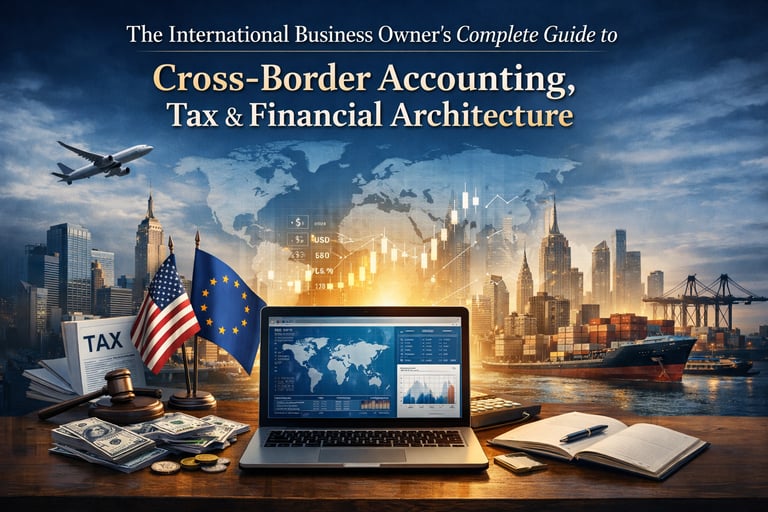
The American Business Owner’s Complete Guide to Taking Your Business International
A comprehensive guide for US business owners expanding internationally, covering cross-border accounting, foreign tax exposure, VAT registration, transfer pricing, multi-currency reporting, entity structure, foreign exchange risk, and global compliance. Built for American businesses operating beyond the United States that need structural clarity. Link
Disclaimer:
Content published by Antravia is provided for informational purposes only and reflects research, industry analysis, and our professional perspective. It does not constitute legal, tax, or accounting advice. Regulations vary by jurisdiction, and individual circumstances differ. Readers should seek advice from a qualified professional before making decisions that could affect their business.
See also our Disclaimer page
Antravia Advisory
Accounting built for complexity
Not legal advice, always verify with your Accountant
Email:
Contact us:
© 2025. All rights reserved. | Disclaimer | Privacy Policy | Terms of Use |
contact@antravia.com
Antravia LLC
941 W Morse Blvd suite 100
Winter Park
Florida
32789