


Further Reading

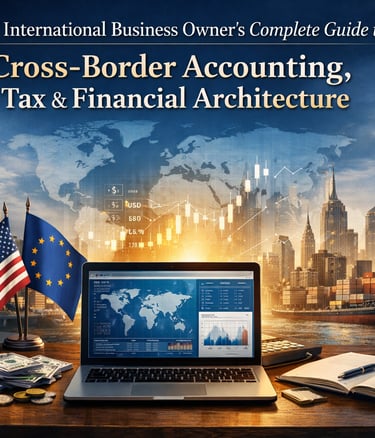
The American Business Owner’s Complete Guide to Taking Your Business International
A comprehensive guide for US business owners expanding internationally, covering cross-border accounting, foreign tax exposure, VAT registration, transfer pricing, multi-currency reporting, entity structure, foreign exchange risk, and global compliance. Built for American businesses operating beyond the United States that need structural clarity. Link
Accounting for Foreign-Owned US LLCs | Practical Bookkeeping Explained
Running a US LLC with a non-US owner should not make bookkeeping difficult. Learn why most providers hesitate, where the real issues arise, and how proper accounting structure solves the problem. Link
Multi-Currency Accounting Explained: Why Profit Changes Due to FX
Why does profit change even when your business hasn’t? A clear explanation of multi-currency accounting, FX gains and losses, and reporting vs settlement currency for international businesses. Link





The Hidden Accounting Traps US Companies Face When Consolidating Foreign Subsidiaries in 2026
Navigate the complex 2026 landscape of international accounting. Learn how to avoid common traps in foreign subsidiary consolidation, from functional currency errors under ASC 830 to the latest OBBBA tax impacts.. Link
International Expenses Accounting and Foreign VAT Recovery
International business expenses often include recoverable foreign VAT. Learn why accounting structure, expense booking, and entity setup determine whether VAT recovery is possible before tax filings even begin. Link
2026 International Tax Changes US Businesses shouldn't ignore: From NCTI/GILTI Adjustments to Withholding and BEAT Impacts
US international tax rules changed in 2026. This article explains how NCTI replaced GILTI, why FDDEI and foreign tax credits now behave differently, and where US businesses are seeing higher cash taxes, withholding risk, and BEAT exposure. Link


VAT.travel International VAT for Travel Agents
Practical insight for agents operating Internationally.. Link
--- Direct tax ---
Effectively Connected Income (ECI): When International Businesses Create U.S. Tax Exposure
Effectively Connected Income (ECI) determines when non-U.S. businesses are taxed in the United States. Learn how ECI arises in practice, common misconceptions, and why many international companies create U.S. tax exposure without realizing it. Link
2026 International Tax Changes US Businesses shouldn't ignore: From NCTI/GILTI Adjustments to Withholding and BEAT Impacts
US international tax rules changed in 2026. This article explains how NCTI replaced GILTI, why FDDEI and foreign tax credits now behave differently, and where US businesses are seeing higher cash taxes, withholding risk, and BEAT exposure. Link



Transfer Pricing for International Businesses: Why Documentation Matters Before $10M Revenue
Transfer pricing isn't just for Fortune 500 companies. Any cross-border related-party transaction needs defensible pricing. Learn why small and mid-size international businesses face transfer pricing risk, what triggers scrutiny, and why documentation matters before an audit. Link
Permanent Establishment Risk: How US Companies Accidentally Create Foreign Tax Exposure
Sending employees abroad, hiring foreign contractors, or delivering services internationally can create permanent establishment exposure and unexpected corporate tax obligations. Learn what triggers PE risk, how treaties provide protection, and why proactive planning prevents costly surprises. Link
Form 5471: A Guide for U.S. Persons With Interests in Foreign Corporations
Form 5471 is required for U.S. persons who own, control, or serve as officers of foreign corporations. Learn who must file, which schedules apply and the penalty structure. Link




VAT.travel International VAT for Travel Agents
Practical insight for agents operating Internationally.. Link
--- Indirect tax ---
USSales.tax Antravia's dedicated page on U.S. Sales Tax, Nexus, and Multi-State Compliance
USSales.tax, operated by Antravia Advisory, helps U.S. and international businesses understand their sales tax exposure and stay compliant across all 50 states. Link
EuroVAT.tax European E.U. VAT for International Businesses
Selling goods or digital services into the European Union triggers VAT obligations that vary by customer location, sales channel, and fulfillment model. OSS, IOSS, platform rules, and upcoming ViDA reforms have simplified some registrations, but they have also shifted liability, reporting, and audit risk. Link


UKVAT.tax UK VAT for US and International Businesses
Supplying goods or digital services to customers in the United Kingdom may trigger UK VAT registration, import VAT obligations, marketplace deemed supplier rules, and ongoing reporting requirements. The UK is no longer part of the EU VAT system. EU simplification regimes do not apply. VAT exposure must be assessed independently under UK legislation, particularly where goods are imported, held in UK inventory, or sold through online platforms.. Link


The Non-US Founder’s Complete Guide to Running a US Business
The Non-US Founder's Complete Guide to Running a US Business - Everything a non-US founder needs to know about setting up, operating, and scaling a US business, from choosing the right entity and opening a bank account, to tax compliance, paying yourself, hiring staff, and managing your home country obligations. Built for international entrepreneurs who want to get it right. Link
--- UK Expats living in the United States ---


Cross-border moves create tax and reporting complexity that is often underestimated, particularly when individuals hold assets, investments, or ongoing income streams across jurisdictions.
For UK citizens relocating to the United States, the interaction between UK tax rules, U.S. tax residency, and treaty provisions can expose income and gains to U.S. taxation earlier than expected, sometimes retroactively, and often without clear warning. Timing, classification, and reporting matter as much as tax rates.
The articles below focus on common UK–U.S. cross-border scenarios we see in practice. They are written to explain where exposure arises, why issues occur, and which areas typically require careful planning or professional advice before and after relocation.
Also see our article on U.S. Expat and Inbound Tax Forms Explained: FBAR, FATCA, PFIC, and Foreign Business Reporting
--- Below is a sample of articles --> see here for more ---
UK Citizens Moving to the U.S.: Tax Issues to Understand Before You Arrive
UK citizens moving to the U.S. face tax exposure before and after arrival. Learn how U.S. tax residency, timing, income recognition, and reporting rules can affect your first year. Link
ISAs and UK Investments Under U.S. Tax: What Stops Being Tax-Free
ISAs and other UK investment wrappers are not tax-free in the U.S. This guide explains how the U.S. treats ISA income, gains, and reporting once you become a U.S. tax resident. Link


Selling UK Property After Moving to the U.S.: Capital Gains and Timing Risks
Selling UK property after becoming a U.S. tax resident can trigger unexpected U.S. capital gains tax. Understand timing risks, FX effects, and double-tax exposure before selling. Link
Specialist advisory for travel companies, OTAs, tour operators and hospitality businesses operating across borders.




Supporting foreign companies establishing or operating in the United States and US companies expanding internationally.
Financial advisory for:
tech & SaaS platforms,
e-commerce and
businesses with complex reporting structures, including deferred revenue or entities with non-US owners.
Advising UK professionals, founders and investors operating between the United Kingdom and the United States.
US Expat? See US Expat page
Not sure where to start? Antravia free Consultation
Disclaimer:
Content published by Antravia is provided for informational purposes only and reflects research, industry analysis, and our professional perspective. It does not constitute legal, tax, or accounting advice. Regulations vary by jurisdiction, and individual circumstances differ. Readers should seek advice from a qualified professional before making decisions that could affect their business. See also our Disclaimer page
Antravia Advisory
Accounting built for complexity
Not legal advice, always verify with your Accountant
Email:
Contact us:
© 2025. All rights reserved. | Disclaimer | Privacy Policy | Terms of Use |
contact@antravia.com
Antravia LLC
941 W Morse Blvd suite 100
Winter Park
Florida
32789