
Part 1: Why E-Commerce Tax Is More Complex Than You Think
The E-Commerce Seller’s Complete Guide to US Tax, Accounting, and Compliance - A clear, practical overview of why e-commerce creates complex US tax and compliance issues, including sales tax nexus after Wayfair, marketplace facilitator rules, income tax, self-employment tax, and why fast growth amplifies multi-state exposure.
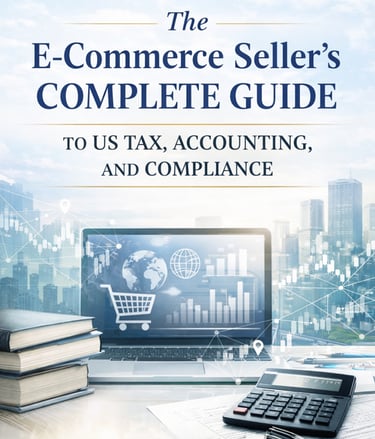
THE E-COMMERCE SELLER’S COMPLETE GUIDE TO US TAX, ACCOUNTING, AND COMPLIANCE
2/24/202619 min read
There is a version of the e-commerce story that we hear frequently at Antravia Advisory - Someone finds a product, lists this on Amazon (or similar), and within a few months they’re generating tens of thousands of dollars in sales from their spare bedroom. Or they launch a Shopify store, run some ads, and watch orders roll in from across the country. The appeal is real as the barriers to entry appear low. The speed at which revenue can scale is unlike almost any other business model.
What we find that doesn’t get talked about nearly enough, until it’s too late, is what happens on the tax, accounting and compliance side of that same story.
Because the same features that make e-commerce so accessible also make it one of the most tax-complex business models that exists for a small or mid-sized company. You are, from the moment you make your first sale, potentially creating tax obligations in multiple states, under multiple tax types, across multiple levels of government and whether you know it or not, whether you intended to or not, and whether anyone told you or not.
This guide wants to change that.
This is the complete picture.The full landscape from entity structure, income tax, self-employment tax, sales tax, bookkeeping, platform-specific issues, international complications, and everything that sits at the intersections between them. Written for sellers who are serious about building a real business and who understand that getting the compliance right is not a bureaucratic inconvenience and it is one of the most important financial decisions they will make.


Why E-Commerce Sellers Face More Tax Complexity Than Almost Any Other Small Business
To understand why e-commerce is so particularly complex from a tax perspective, it helps to compare it with a more traditional business. Consider a local plumber. He works in one city, maybe one county. He has one type of income. He has one or two employees. His tax obligations are largely confined to a single state, a handful of federal forms, and a relatively predictable annual cycle.
Now consider an e-commerce seller doing $400,000 a year on Amazon FBA. She has inventory sitting in Amazon fulfilment centres across potentially eight, ten, or twelve states and states she has never visited, never incorporated in, never hired anyone in, and never given a second thought to. That physical presence generally creates sales tax nexus in those states, but what it actually requires her to do varies.
In some states, a marketplace-only seller with inventory in a fulfilment centre may not be required to register, because the marketplace facilitator (Amazon) is handling collection and remittance and the state has not imposed an independent registration obligation on the underlying seller. In other states, registration is required regardless. The Streamlined Sales Tax project publishes state-by-state guidance on exactly this question, and the answers differ materially across states. On top of this, she has crossed the economic nexus threshold in another six states purely based on the volume of sales she made there, even without any physical inventory. The result is a multi-state compliance picture, so potentially spanning a dozen or more states, where each state’s rules about registration, collection, filing frequency, taxable products, and penalties need to be understood individually.
That’s just sales tax. She also owes federal income tax on her profits, state income tax in her home state, and, if she’s operating as a sole proprietor or through a pass-through entity, self-employment tax on top of ordinary income tax rates. Her profits look healthy on paper, but if she hasn’t been setting aside money for each of these obligations throughout the year, the bill at year-end can be genuinely shocking.
Meanwhile, her bookkeeping might not be up to date and not because she’s been careless, but because Amazon pays her through periodic settlement payouts that bundle sales revenue, fees, refunds, chargebacks, reimbursements, and promotional credits into a single deposit figure that bears almost no resemblance to her actual taxable income. Her bank account shows regular transfers from Amazon. Her bookkeeper records them as revenue. Neither of them has reconciled back to the actual settlement reports. Her profit figure is wrong, her COGS is untracked, and her deductions are being missed.
This is not a fictional worst case. It is, with minor variations, the situation that a significant proportion of growing e-commerce sellers find themselves in and often only discovering the full picture when they apply for a business loan, try to raise investment, prepare to sell the business, or receive a letter from a state revenue authority.
The complexity comes from the nature of the business model itself. And understanding it fully and before it becomes a problem, is what this guide is designed to help you do.
The Three Completely Separate Tax Obligations Most Sellers Don’t Realize They Have
One of the most consistent sources of confusion among e-commerce sellers, particularly those who are newer to business ownership, is treating “tax” as a single thing. There is a vague sense that tax is something you deal with once a year, probably in the spring, probably with some kind of accountant, and the number that comes out at the end is what you owe.
The reality is that running an e-commerce business creates three fundamentally distinct categories of tax obligation and each governed by different laws, administered by different authorities, calculated on different bases, and due on different schedules.
Sales Tax
Sales tax is a consumption tax. It is charged to your customer at the point of sale, collected by you as the seller, held in trust, and remitted to the state on a regular basis. You do not personally bear the economic cost of sales tax but your customer does. Your role is that of collection agent for the state.
The reason sales tax is so complex for e-commerce sellers is that the United States does not have a single national sales tax. It has a patchwork of 45 different state-level sales tax systems (plus the District of Columbia), each with its own rules, rates, thresholds, product categories, and filing requirements. Five states - Alaska, Delaware, Montana, New Hampshire, and Oregon - have no state sales tax at all. The other 45 each operate independently. Some have local sales taxes layered on top of state rates, creating situations where the effective tax rate varies by county, city, or even special tax district. California alone has hundreds of different effective rates depending on the exact delivery address.
The obligation to collect and remit sales tax in a given state is triggered by the concept of “nexus”, which we will cover in depth in Part 3. For now, the key point is that nexus can be created by physical presence (like inventory in an Amazon warehouse) or by economic activity (like exceeding a threshold of sales into that state), and that crossing the nexus threshold means you are required by law to register, collect, and file and regardless of whether you knew about the threshold, and regardless of whether you intended to create that obligation.
Failing to collect sales tax when you have nexus does not make the obligation go away. It means you owe it yourself, out of your own pocket, plus interest, plus penalties.
Income Tax
Income tax is a completely separate obligation. It is not charged to your customers. It is calculated on your business profits so the money you kept after paying your costs, and it is owed by you personally or by your business entity.
For most small e-commerce sellers operating as sole proprietors or through single-member LLCs, business income passes through to their personal tax return and is taxed at their individual income tax rate. For sellers who have elected S-Corp status, income passes through similarly but with a more complex structure involving a required salary component. For C-Corps, the business itself pays tax at the federal corporate rate of 21%, and then owners pay again on any distributions they take.. the notorious double taxation.
The fundamental point is this: income tax and sales tax are entirely different things. Sales tax is collected from customers and passed on to the state. Income tax is calculated on your profits and owed by you. A seller who has been diligently collecting and remitting sales tax has addressed one category of obligation. They have not touched income tax. And a seller who has filed their income tax return has addressed a second category of obligation. They have not addressed sales tax. Both are required. Neither substitutes for the other.
Self-Employment Tax
The third category is one that catches many first-time business owners completely off guard: self-employment tax.
When you work as an employee, your employer withholds Social Security and Medicare taxes from your pay cheque (collectively called FICA taxes) and matches that contribution on your behalf. The total cost of this arrangement is 15.3% of your wages, but you only see half of it, because your employer covers the other half before you ever receive your pay.
When you run your own business, there is no employer. You are both the employee and the employer. Which means you owe the full 15.3% on your net self-employment income and not just the half that employees see. For a seller netting $100,000 in profit from a sole proprietorship or single-member LLC, the self-employment tax bill is approximately $14,130, calculated on 92.35% of net earnings (a small statutory adjustment). This is in addition to, not instead of, federal and state income tax.
To illustrate the combined burden: take a single filer in California with $120,000 of net profit from a sole proprietorship. Self-employment tax at 15.3% applies to 92.35% of net earnings... roughly $16,940. After deducting half of SE tax as an above-the-line deduction, taxable income for federal purposes is approximately $111,530 (before other deductions). Federal income tax at applicable 2024 rates for a single filer adds roughly another $17,000–$19,000 at that income level, and California state income tax adds further on top. The combined effective burden across all three taxes so SE tax, federal income tax, and state income tax, can approach or exceed 40% of net profit in high-tax states at this income level, depending on filing status, deductions available, and the specific state. In lower-tax states, or with the QBI deduction in play, the picture is more favourable. The point is not a precise universal rate and it is that the stacking of three separate tax obligations consistently produces a total burden that surprises sellers who were only mentally budgeting for income tax alone.
The good news is that there are legitimate strategies for managing this burden and most notably the S-Corp election, and we cover those in detail in Part 2 and Part 4. But you cannot access those strategies if you don’t first understand that self-employment tax exists and how it works.


How the 2018 South Dakota v. Wayfair Ruling Changed Everything
Prior to June 2018, there was a clear and, if increasingly inconvenient, rule in US sales tax law: a state could only require you to collect sales tax if you had a physical presence in that state. This rule came from a 1992 Supreme Court case called Quill Corp. v. North Dakota, which held that the Commerce Clause of the US Constitution prohibited states from imposing tax collection obligations on sellers who had no physical connection to the state.
For decades, this rule more or less held. It became increasingly strained as e-commerce grew and states were watching billions of dollars in untaxed online sales flow through their residents’ hands, generating no sales tax revenue, but the constitutional principle stood.
Then came South Dakota v. Wayfair.
In 2016, South Dakota passed a law that deliberately violated the Quill standard. It required out-of-state sellers to collect sales tax if they made more than $100,000 in sales into South Dakota or completed more than 200 separate transactions in the state, and this was regardless of physical presence. South Dakota did this explicitly to force a Supreme Court challenge. Wayfair, Overstock, and Newegg were the defendants.
On June 21, 2018, the Supreme Court ruled 5-4 in favour of South Dakota. The Quill physical presence rule was overturned. States now had the constitutional authority to require sales tax collection from sellers based purely on the volume of their economic activity in the state and what became known as “economic nexus.”
Within months, virtually every sales tax state had passed or was passing its own economic nexus legislation. The specific thresholds vary significantly by state. Many states use $100,000 in sales or 200 transactions as the trigger, mirroring the South Dakota law although though a number of states have since eliminated the transaction count and use only the dollar threshold. Others set higher bars: Texas, for example, has an economic nexus threshold of $500,000 in sales in the preceding twelve months, which is five times the most common threshold. Some states have additional complexity around how sales are measured and what counts toward the threshold. The Part 3 state-by-state breakdown covers these in full. The underlying principle, however, is now consistent across the country: if you sell enough into a state, you have an obligation to collect and remit sales tax there, and “enough” is defined differently in every state.
For e-commerce sellers, the Wayfair decision was genuinely transformative. Before Wayfair, an Amazon seller with no warehouses in Texas had no sales tax obligation in Texas. After Wayfair, the same seller, once they crossed Texas’s economic nexus threshold, may have a legal obligation to register in Texas, configure their sales tax collection for Texas sales, and file and remit Texas sales tax on whatever schedule Texas required. And then do the same for every other state where they crossed the threshold.
The practical consequence for a seller who was already doing meaningful volume when Wayfair was decided, or who has been growing since and has since crossed nexus thresholds in multiple states, is that there is likely a period of back liability already accumulated. The statute of limitations varies by state, typically three to four years from the date a return was filed, but this comes with a critical caveat that changes the picture for most delinquent sellers: in many states, if no return was ever filed, the limitations period may never begin to run at all. A state cannot be barred from assessing tax for a period in which the seller never submitted a return, because there is no filed return to start the clock. For sellers who have simply never registered and never filed in a state, the exposure is not necessarily capped at three or four years but it may extend back to the point nexus was first created, however long ago that was. This is one of the most important reasons to address delinquent obligations through a structured process rather than hoping the clock runs out. This is why Voluntary Disclosure Agreements exist, and why understanding your historical nexus position matters so much.
We will cover economic nexus thresholds, physical nexus, marketplace facilitator laws, and the mechanics of sales tax compliance in full in Part 3. The Wayfair context here is essential because it frames everything else: the world changed in 2018, and sellers who built their businesses, or their assumptions, in the pre-Wayfair era are operating with an outdated mental model that is costing them.
The Difference between Amazon Collecting Sales Tax and you having Nexus
This is one of the most pervasive and dangerous misconceptions in e-commerce tax, and it deserves its own direct treatment. Amazon collects sales tax on your behalf for the vast majority of transactions you make through its marketplace. In states that have enacted Marketplace Facilitator laws, which is now essentially every sales tax state, Amazon is legally required to collect, report, and remit sales tax on sales it facilitates. You, as the seller, do not handle the mechanics of collection. Amazon does it. The tax goes from the buyer to Amazon to the state. You never see it.
Many sellers conclude from this that their sales tax situation is handled. Amazon collects it, Amazon remits it, nothing more for me to do. This conclusion is wrong in several important ways.
First: Amazon collecting sales tax on marketplace sales does not automatically relieve you of any registration obligation in states where you have nexus. State treatment here is genuinely inconsistent. Some states do require marketplace sellers to register even when a facilitator is collecting on all their sales. Others do not impose a registration obligation on marketplace-only sellers, even with physical nexus through FBA inventory. The Streamlined Sales Tax project maintains state-by-state “Marketplace Seller” guidance that maps this out, and the variation is significant enough that blanket statements in either direction are misleading. Your specific state-by-state picture depends on your actual fact pattern: where your inventory is, how much you’re selling through marketplace versus non-marketplace channels, and what each relevant state’s rules say for sellers in that position.
Second: Amazon collecting sales tax on your Amazon sales does not cover your sales made anywhere else. If you also sell through your own Shopify store, your own website, at trade shows, through wholesale agreements, or through any channel other than the Amazon marketplace, you are solely responsible for sales tax collection and remittance on those sales. Amazon’s marketplace facilitator collection does not extend beyond Amazon. The moment you diversify your sales channels, which almost every serious e-commerce business eventually does, you take on direct sales tax obligations that you cannot delegate to a platform.
Third, and most critically: the Amazon marketplace facilitator collection has nothing whatsoever to do with whether you have nexus in a given state. Nexus is a legal status. It describes whether you have a sufficient connection to a state to be subject to its tax laws. It exists regardless of whether anyone is collecting tax on your transactions. Amazon storing your FBA inventory in a warehouse in Pennsylvania creates nexus for you in Pennsylvania. Period. The fact that Amazon collects Pennsylvania sales tax on your Pennsylvania sales through the marketplace does not make the nexus disappear. It does not eliminate your income tax exposure in Pennsylvania. It does not prevent Pennsylvania from auditing your activities. And it does not cover any obligations you might have in Pennsylvania related to non-marketplace sales.
The short version: Amazon collecting sales tax on your marketplace sales is a helpful operational convenience. It is not a compliance strategy. It does not substitute for understanding where you have nexus, registering in those states, and managing your full obligations across every channel through which you sell.


Why Growing Fast makes your Compliance Problem Worse, not Better
There is an understandable temptation to treat compliance as something to address later, so once the business is more stable, once there’s more cash, once things settle down. In most areas of business, this kind of prioritization is sensible. You focus on the things that directly generate revenue and defer the back-office work until you can afford to do it properly.
With tax compliance, this logic runs in reverse. Deferring compliance in e-commerce does not make the problem smaller. It makes it larger, in direct proportion to your growth.
Consider how nexus accumulates. In year one, you’re selling $150,000 a year primarily on Amazon. Your FBA inventory sits in warehouses in five or six states, creating physical nexus in those states. You haven’t registered in any of them, haven’t been collecting for your Shopify store sales, and haven’t thought much about it. The potential back liability exists but it is relatively contained.
In year two, revenue doubles. You’re now in eight states for physical nexus and have crossed economic nexus thresholds in another four. The non-marketplace Shopify sales you’ve been making, untaxed, have grown with the business. The delinquent returns that would need to be filed if you came clean are now two years of activity across twelve states. The interest and penalties are accruing.
In year three, you diversify onto Walmart Marketplace and TikTok Shop. Revenue hits $700,000. Nexus now exists in fourteen states. You’ve been in operation for three years. You start thinking about selling the business, and the prospective buyer’s accountants do due diligence.
Due diligence finds twelve states with uncollected sales tax going back three years, unregistered nexus in six additional states, income tax filings that have not been made in states where you have income tax nexus, and books that haven’t been properly reconciled in two years. The buyer’s offer is reduced by the estimated value of the liability. Or the deal falls through entirely. Or the seller ends up personally liable for tax obligations that were never disclosed.
This scenario is not hypothetical. It plays out regularly with e-commerce businesses, and the common thread is always the same: the compliance problem was small when it started, manageable when it was fresh, and ignored until it became expensive.
Getting current is harder than staying current. The work required to retroactively reconstruct years of books, file delinquent returns in multiple states, negotiate Voluntary Disclosure Agreements, and remediate back liabilities is significantly more expensive and time-consuming than maintaining compliance would have been. Not by a small margin. Often by a factor of five or ten.
The sellers who handle this best are the ones who build compliance into the infrastructure of the business from the beginning and not because they enjoy paperwork, but because they understand that scale amplifies everything, including problems that were easy to ignore when they were small.
Who this Guide is for
This guide has been written with a specific set of readers in mind, and it is worth being clear about that so you can calibrate how to use it.
Amazon FBA sellers are perhaps the most common type of e-commerce seller who finds themselves with complex tax situations they didn’t anticipate. FBA’s model, where Amazon holds and ships your inventory, creates multi-state physical nexus by default, almost from the moment you send in your first shipment. If you are selling on Amazon FBA and have not addressed nexus, this guide will show you exactly what you’re dealing with and what to do about it.
Shopify store owners face a different but equally real set of challenges. Unlike marketplace sellers who can rely on the platform’s facilitator collection for marketplace transactions, Shopify sellers own their sales tax obligation entirely. Every state where you have nexus is a state where you must configure collection, register, file, and remit, entirely under your own steam. Shopify has useful tools, but the compliance decisions are yours.
Etsy sellers operate in a middle position. Etsy is a marketplace facilitator and collects sales tax on your behalf in most states. But Etsy does not cover non-Etsy sales, and as your business grows beyond the Etsy platform, the compliance picture expands quickly.
Multi-platform sellers - those who sell across Amazon, Shopify, Etsy, their own website, and perhaps wholesale channels simultaneously, have the most complex situation of all. Nexus aggregates across all of your activity. Income from all channels flows to your personal or business return. Books need to reflect every platform’s data. This guide addresses the multi-platform reality throughout, not just platform by platform.
Dropshippers have a uniquely complicated tax situation. You take the orders, a supplier ships directly to the customer, and you never hold the inventory. The sales tax treatment of dropshipping, who collects, who owes, and what the supplier relationship means for nexus, is genuinely complex and frequently misunderstood. We address it directly in Part 5.
Non-US sellers selling into the US deserve particular attention, and this guide gives it to them. The UK seller setting up an Amazon US account, the EU brand building a direct-to-consumer US presence, the Canadian entrepreneur launching on Shopify and shipping to US customers, all of these sellers have US tax obligations that most advisors in their home countries are not equipped to explain. The combination of sales tax nexus, US income tax exposure through Effectively Connected Income, entity filing obligations, and the interaction with home-country VAT systems creates a compliance picture that is genuinely unique and consistently underserved. Part 8 covers this in full. It is one of the most important sections of this guide.
How to Use this Guide: The Compliance Journey from First Sale to Scaling
This guide is structured to follow the natural arc of an e-commerce business, so from the entity and structure decisions you need to make before or just after your first sale, through the ongoing compliance mechanics of sales tax, income tax, and bookkeeping, through the platform-specific issues that arise as you diversify, and all the way to the scaling decisions and exit planning that matter when the business is genuinely large.
You do not need to read it front to back, though it was written to reward that approach. If you are in a specific situation, so a UK seller trying to understand your US obligations, a seller who has fallen behind on sales tax and needs to understand your options, an FBA seller trying to understand the Amazon 1099-K reconciliation problem, you can navigate directly to the relevant part.
A few things to know about how to read it:
The guide is written to give you genuine understanding, not just a list of rules. Rules change. Thresholds are updated. Laws are passed. The goal here is for you to understand why the rules are the way they are, which gives you the ability to apply that understanding even as the details shift.
The guide is also written to help you have better conversations with your accountant and advisors but not to replace them. Tax and compliance decisions at the level of complexity described here involve facts and circumstances specific to your business, your entity, your product mix, your state of residency, and a dozen other variables that a guide cannot account for individually. What a guide can do is ensure that when you sit down with an advisor, you are not starting from zero. You know the right questions to ask. You know what good advice looks like. You know which red flags to watch for.
Where Antravia Advisory’s services are directly relevant, whether it’s our US sales tax compliance work through ussales.tax, our support for international sellers navigating US entity and filing obligations, or our full-service accounting and advisory work for growing e-commerce businesses, we have noted that throughout.
The goal, always, is that you leave this guide better equipped than you arrived.
A final point
Getting tax compliance wrong as an e-commerce seller is not a matter of minor administrative tidiness. The stakes are real.
At the lower end of the consequence spectrum, there are late filing penalties, interest on unpaid balances, and the time and cost of retroactively addressing what should have been handled in real time. These are annoying and expensive, but survivable.
At the higher end, there are state audits triggered by unfiled returns or flagged nexus, back tax assessments covering multiple years with compounding interest, personal liability for unpaid sales tax if you have collected it and failed to remit it (in many states, officers and owners can be held personally liable for this, even if the business is an LLC), and deals falling through or purchase prices being significantly reduced due to undiscovered compliance liabilities.
For non-US sellers specifically, the stakes have additional dimensions that domestic sellers don’t face. Unaddressed US tax obligations can result in FDAP withholding on payments made to foreign persons or entities thus meaning platforms or counterparties may be required to withhold 30% of gross payments if proper documentation hasn’t been filed. Missing required US tax returns can create IRS assessments that become increasingly difficult and expensive to resolve from outside the country. And non-compliance discovered during due diligence, particularly missed Form 5472 filings, which carry a $25,000 per-year penalty floor, can materially affect the value and viability of a business sale or investment round. The mechanisms here are specific and serious, and Part 8 covers them in full.
None of this is to frighten you into paralysis. The e-commerce opportunity is real, and the compliance burden, properly managed, built into the right systems, supported by the right professionals, is entirely manageable. Thousands of sellers navigate it successfully every year. The ones who do it well are the ones who understand the landscape, take it seriously, and address it proactively.


About Antravia Advisory
Antravia Advisory is a US-based tax and accounting advisory firm headquartered in Winter Park, Florida, operating nationally and internationally.
We advise international businesses entering the United States and complex US companies operating across multiple states, entities, and revenue structures. Our work spans advanced tax strategy, multi-state sales tax oversight, cross-border structuring, and high-level accounting architecture for e-commerce brands, subscription and SaaS businesses, platform-based models, and multi-entity groups.
We work with founders and leadership teams who require technical precision, structural clarity, and financial frameworks built for scale, capital events, and long-term resilience.


The E-Commerce Seller’s Complete Guide to US Tax, Accounting, and Compliance
Part 1 — The Big Picture
Part 2 — Entity Structure
Part 3 — Sales Tax
Part 4 — Income Tax
Part 5 — Platform-Specific Issues
Part 6 — Bookkeeping and Accounting Architecture
Part 7 — Payroll and Hiring
Part 8 — International Sellers Selling Into the US
Part 9 — Sales Tax Automation
Part 10 — Catching Up
Part 11 — Scaling and Exit Planning
Part 12 — Annual Compliance Calendar
Part 13 — Working With Professionals
Disclaimer:
Content published by Antravia is provided for informational purposes only and reflects research, industry analysis, and our professional perspective. It does not constitute legal, tax, or accounting advice. Regulations vary by jurisdiction, and individual circumstances differ. Readers should seek advice from a qualified professional before making decisions that could affect their business.
See also our Disclaimer page
Antravia Advisory
Accounting built for complexity
Not legal advice, always verify with your Accountant
Email:
Contact us:
© 2025. All rights reserved. | Disclaimer | Privacy Policy | Terms of Use |
contact@antravia.com
Antravia LLC
941 W Morse Blvd suite 100
Winter Park
Florida
32789