
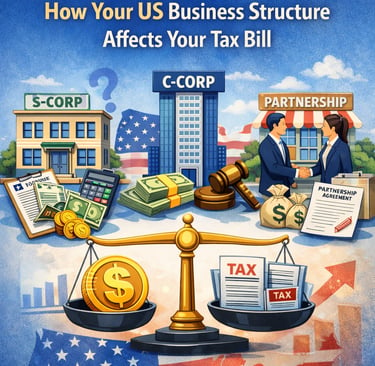
S-Corp, C-Corp, or Partnership? How Your US Business Structure Affects Your Tax Bill
Choosing the wrong business entity can cost thousands in unnecessary tax. This guide explains how S-Corps, C-Corps, and partnerships are taxed differently, and what the choice means for business owners taking money out of their company.
3/2/202617 min read
S-Corp, C-Corp, or Partnership? How your US Business Structure affects your Tax Bill
Few decisions have as lasting an impact on a business owner's finances as the choice of legal entity. Unlike selecting a logo or picking an office location, the entity you form, or fail to form, determines how every dollar your business earns is taxed, how much of your profits you get to keep, and how painful it becomes when you eventually want to sell. And yet the decision is often made hastily, based on what a startup forum recommended or what the cheapest formation service offered as a default.
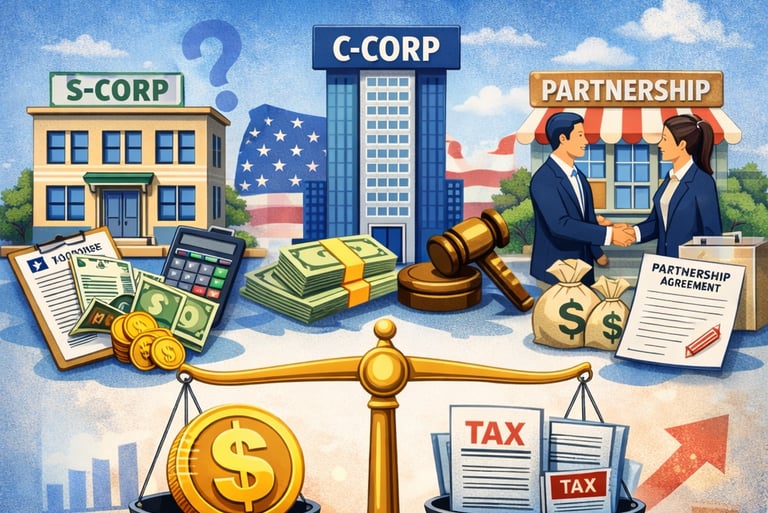
The three dominant structures for operating businesses in the United States, namely the C-Corporation, the S-Corporation, and the partnership (including multi-member LLCs taxed as partnerships), are governed by fundamentally different tax regimes. They differ not just in tax rates, but in how income flows, who pays the tax, when distributions are taxed, and what happens when you want to exit. Getting this right at formation is one of the most high-leverage tax decisions an entrepreneur makes. Getting it wrong can mean years of unnecessary tax drag or a painful, expensive restructuring down the road.
This guide breaks down each structure in practical terms and not just what the rules are, but what they mean for your actual tax bill.


The C-Corporation: Double Taxation and when it actually makes sense
The C-Corporation is the default corporate form. When you incorporate without making an S-Corp election, you have a C-Corp. It is also the structure that powers every publicly traded company in America, which tells you something important: it is not inherently bad. But it comes with a structural feature that makes many small business owners recoil — double taxation.
Here is how it works. The C-Corp is a separate taxpaying entity. It files its own return and pays federal corporate income tax on its profits at a flat 21% rate, a rate established by the Tax Cuts and Jobs Act of 2017. That tax is paid at the corporate level. When the corporation then distributes its after-tax profits to shareholders in the form of dividends, those shareholders pay tax again on the dividend income — at rates of 0%, 15%, or 20% depending on their income level (qualified dividends) or at ordinary income rates for non-qualified dividends. The same dollar of earnings gets taxed twice: once going through the corporation, and once coming out to the owner.
In concrete terms, consider a C-Corp that earns $500,000 in profit. It pays 21% corporate tax, leaving $395,000 of after-tax income. If the owner wants to take that out as a dividend, they might pay another 15–20% tax on those distributions. The combined effective rate on that original $500,000 can approach 37–40%, depending on the owner's overall income situation. Compare that to a pass-through structure where the same $500,000 flows directly to the owner's personal return and may be taxed at a top marginal rate of 37%, potentially reduced by the Section 199A qualified business income deduction (up to 20% for eligible pass-throughs), and the structural disadvantage of the C-Corp becomes clear for an owner who wants to take money out regularly.
But the C-Corp structure is not without genuine advantages. For businesses that plan to reinvest profits back into growth rather than distribute them, the 21% corporate rate is actually quite favorable. An owner who pays themselves a market-rate salary (deductible to the corporation) and leaves remaining profits inside the company to fund operations, hire staff, or invest in capital equipment is retaining those earnings at a 21% tax cost — lower than the top individual marginal rate of 37%. This is the deferral strategy: pay the lower corporate rate now, distribute later when you can manage the timing or when you have an exit.
C-Corps are also the preferred structure for venture-backed companies and businesses planning to raise institutional equity. S-Corps cannot have more than 100 shareholders, cannot have foreign shareholders, and cannot have multiple classes of stock — restrictions that make them incompatible with the preferred equity structures that investors require. If your growth path includes venture capital or a path to a public offering, the C-Corp is not just an option; it is essentially a requirement.
The Qualified Small Business Stock (QSBS) exclusion under Section 1202 also applies exclusively to C-Corp stock. If you hold qualifying C-Corp stock for more than five years, you may be able to exclude up to $10 million (or 10x your basis, whichever is greater) of gain from federal income tax when you sell. For founders in high-growth businesses, this exclusion can dwarf the cost of double taxation during the operating years.


The S-Corporation: Pass-Through Taxation with Strings Attached
The S-Corporation is Congress's answer to the double taxation problem for small business owners who want corporate-style legal protection without the two-layer tax structure. An S-Corp is not a separate taxpaying entity in the traditional sense. Instead, its income and losses pass through directly to shareholders' personal tax returns, proportionate to their ownership. The corporation files a return (Form 1120-S) to report income and allocations, but it pays no federal income tax itself. Shareholders report their share of income on Schedule E of their personal returns and pay tax at individual rates.
This eliminates the double-taxation problem for distributed profits. If an S-Corp earns $500,000 and distributes it to a sole owner, that owner pays tax once, at their individual marginal rate, potentially reduced by the Section 199A deduction if the business is a qualifying trade or business. No corporate-level tax, no second layer on distributions.
The Reasonable Salary Requirement and SE Tax Planning
The most significant tax planning advantage of the S-Corp structure — and the one most discussed in small business circles — is the self-employment tax savings. Owners of sole proprietorships and single-member LLCs pay self-employment (SE) tax on their entire net profit: 15.3% on the first $176,500 of net earnings (in 2025) and $184,500 in 2026 and 2.9% above that, representing both the employee and employer portions of Social Security and Medicare. On a $300,000 profit, that is an enormous additional tax burden on top of income tax.
S-Corp shareholders who work in the business are required to pay themselves a "reasonable salary" for the services they perform and this salary is subject to payroll taxes just like any W-2 employment income. However, distributions of profit above and beyond that salary are not subject to SE tax or payroll tax. They flow out as shareholder distributions, taxed only as ordinary income on the personal return.
The strategy, therefore, is to set the reasonable salary at an amount that genuinely reflects market compensation for the owner's role, pay payroll taxes on that salary, and take additional profit as distributions that are free of the employment tax layer. Done correctly, and with a salary that the IRS would consider genuinely reasonable, this can save an S-Corp owner thousands of dollars per year. Done aggressively, with an artificially low salary designed purely to minimize payroll taxes, it becomes one of the IRS's most common audit targets.
S-Corp Eligibility: The Rules That Disqualify Many Businesses
S-Corp status is an election, made by filing Form 2553 with the IRS. But not every business qualifies. The eligibility requirements are strict and, importantly, ongoing, so a misstep can inadvertently terminate the S election, reverting the entity to C-Corp status and triggering significant tax consequences.
To qualify as an S-Corp, the business must be a domestic corporation, have no more than 100 shareholders, have only one class of stock (though differences in voting rights are permitted), and have shareholders who are individuals, certain trusts, or estates and not partnerships, corporations, or non-resident aliens. These restrictions immediately rule out S-Corp status for businesses with foreign investors, businesses that have issued preferred equity with different economic rights, and businesses planning to take on institutional investment with complex capital structures.
For closely held service businesses, so medical practices, law firms, consulting companies, accounting firms, and similar owner-operator businesses with a small number of US-based owners, the S-Corp structure is often the optimal choice, combining pass-through taxation with meaningful payroll tax savings.


Partnerships and Multi-Member LLCs: Maximum Flexibility, Maximum Complexity
The partnership tax regime is the most flexible of the three structures, and by far the most complex. A partnership, which includes general partnerships, limited partnerships, limited liability partnerships, and multi-member LLCs that have not elected to be treated as a corporation, is a pass-through entity like the S-Corp, meaning profits and losses flow through to partners' personal returns without a corporate-level tax. But that is roughly where the similarities end.
Unlike S-Corps, partnerships face almost no restrictions on who can be a partner. Foreign investors, corporations, trusts, other partnerships, all can hold partnership interests. There is no limit on the number of partners. And crucially, partnerships can have multiple classes of economic interest with different rights to income, loss allocations, distributions, and liquidating proceeds. This makes the partnership the vehicle of choice for private equity funds, real estate ventures, joint ventures between corporations, and any arrangement where different investors need to receive economics tailored to their specific risk profile and return requirements.
Special Allocations: The Partnership's Unique Power
One of the most powerful features of partnership taxation is the ability to make special allocations and that is, to allocate income, gain, loss, deduction, or credit in proportions that differ from the partners' overall ownership percentages. An S-Corp must allocate income strictly pro rata to shares. A partnership, by contrast, can give one partner 80% of the depreciation deductions while splitting cash flow equally, or allocate early-year losses to the investor partner while later-year profits skew toward the operating partner. This flexibility makes the partnership indispensable for structuring complex deals.
However, special allocations must have "substantial economic effect" under the Section 704(b) regulations so they cannot be purely tax-motivated allocations with no corresponding economic reality. The rules governing substantial economic effect are among the most technical in the tax code, requiring capital account maintenance, deficit restoration obligations, and qualified income offsets. Getting this wrong can cause the IRS to reallocate income in ways the partners did not intend.
How Partners Take Money Out: Guaranteed Payments vs. Distributive Shares
Partners receive income from their partnerships in two primary forms: guaranteed payments and distributive shares. Guaranteed payments are fixed amounts paid to a partner for services or capital, determined without regard to the partnership's income so they function like salary, are deductible to the partnership, and are treated as ordinary income subject to self-employment tax for the recipient partner. Distributive shares are allocations of partnership income (or loss) that the partner reports on their personal return, whether or not they actually received a cash distribution.
This last point, the distinction between income allocation and actual cash distribution, is a critical concept in partnership taxation known as phantom income. A partner can be allocated income and thus owe tax on it without receiving any cash. This occurs regularly in real estate partnerships and operating businesses where cash is reinvested rather than distributed. Partners need sufficient liquidity to pay their tax on allocated income, regardless of distributions.
For general partners and active LLC members, distributive shares from a trade or business are generally subject to self-employment tax. For limited partners, the treatment is more nuanced and limited partner shares are generally exempt from SE tax, a rule that has generated significant litigation around LLC members who claim limited partner status while actively managing the business.


How Owners Extract Value: A Structural Comparison
The choice of entity dramatically shapes how, and at what tax cost, owners can take money out of their business. This is where the abstract differences between structures translate into real dollars.
A C-Corp owner who is also an employee can pay themselves a salary, which is deductible to the corporation and subject to payroll taxes for the owner. Dividends paid from after-tax corporate profits are taxable to the shareholder at qualified dividend rates (generally 15–20%) but are not deductible to the corporation. Loans from the corporation to shareholder-employees can serve as a tax-advantaged mechanism for accessing funds, though the IRS scrutinizes below-market loans and can recharacterize them as dividends. Retained earnings left inside the corporation grow at the 21% tax rate, giving the owner deferral benefits and the ability to time eventual distributions for when their personal tax rate is most favorable.
An S-Corp owner-employee must take a reasonable salary for services rendered to the business. This salary is subject to payroll taxes. Remaining profit can be distributed as shareholder distributions, which are not subject to SE tax, and are taxed only at the owner's ordinary income rate. The discipline required is in getting the reasonable salary right, so too low, and the IRS may reclassify distributions as wages; too high, and you are unnecessarily increasing your payroll tax burden. The tax savings come from the middle ground: a genuine, defensible salary for the work performed, with excess profit distributed tax-advantageously.
In a partnership, active general partners and managing members who receive guaranteed payments for services treat those payments like salary and they are subject to self-employment tax and ordinary income tax. Distributive shares of business income are also generally subject to SE tax for active partners, though planning around the at-risk rules, passive activity rules, and limited partner carve-outs can alter this. One distinctive feature is that partners can receive distributions of capital account balances without additional income tax, to the extent those distributions do not exceed their basis so making the return of invested capital tax-free.


The Built-In Gains Tax: The Trap That Catches Business Owners Before a Sale
One of the most dangerous and often most overlooked, tax traps in entity planning is the built-in gains (BIG) tax, which applies when a C-Corp converts to an S-Corp and then sells appreciated assets. Understanding this trap is critical for any C-Corp owner who is contemplating a structural change, particularly in anticipation of a sale.
Here is the problem. When a C-Corp elects S-Corp status, the IRS does not simply forget about the appreciation that built up during the C-Corp years. If the business holds assets, real estate, intellectual property, customer relationships, inventory, equipment, that had appreciated in value as of the date of the S election, and if those assets are sold within five years of the conversion, the corporation will owe BIG tax on the gain that was built in at the time of conversion. The BIG tax is assessed at the highest corporate rate (currently 21%), even though the business is now an S-Corp passing income through to individual shareholders. The individual shareholders then also pay tax on the gain flowing through the S-Corp, creating a version of double taxation on the portion of gain that was built in during the C-Corp period.
In practice, this trap most commonly catches business owners who, upon hearing that they have a potential buyer, decide to quickly convert from a C-Corp to an S-Corp to avoid double taxation on the sale. If they sell within the five-year recognition period, the BIG tax applies to the appreciation that existed at conversion, thus meaning the maneuver backfires. The sale triggers both the BIG tax at the corporate level and shareholder-level income tax on the pass-through, potentially resulting in higher total tax than if the C-Corp had simply sold the assets and distributed the after-tax proceeds.
The five-year period runs from the date of the S election. Businesses that converted to S-Corp status more than five years before the sale are not subject to BIG tax. This is why early structural planning matters so much: a business owner who recognizes five years before a potential exit that their C-Corp status is suboptimal can convert to S-Corp, wait out the recognition period, and then sell with pass-through taxation applying to the entire gain.
Partnerships that have contributed appreciated property face a related concept under Section 704(c), which requires the contributing partner to recognize the built-in gain on that property when the partnership sells it. The rules are technically different from BIG but reflect the same principle: the tax system attempts to ensure that pre-contribution appreciation is eventually taxed to the party who built it up.


State Tax Considerations: The Layer Most Owners Forget
Federal tax treatment is only part of the entity selection calculus. State taxation adds a significant additional dimension, and the rules vary dramatically by state. Some states recognize S-Corp elections and tax S-Corps as pass-throughs just as the federal government does. Others impose entity-level taxes on S-Corps, effectively adding a layer of tax at the state level even though the federal treatment is pass-through. California, for example, imposes an annual franchise tax on S-Corps as well as a 1.5% tax on S-Corp net income at the entity level and in addition to the shareholder's personal income tax on their allocable share.
Many states have enacted pass-through entity (PTE) taxes in response to the federal $10,000 SALT deduction cap introduced in 2017. These elective taxes allow S-Corps and partnerships to pay state income tax at the entity level and deduct it federally, allowing the owners to effectively circumvent the SALT cap limitation. The availability and mechanics of PTE elections vary significantly by state, and the benefits need to be modeled carefully to ensure the elective tax results in a net tax savings.
Some states do not impose entity-level income taxes on partnerships, making the partnership structure particularly attractive in those jurisdictions. Others impose franchise taxes, minimum taxes, or gross receipts taxes that apply regardless of profitability. A business operating across multiple states must also grapple with nexus rules, apportionment formulas, and the administrative burden of filing in every state where it has economic presence, a complexity that multiplies with the number of partners or shareholders who themselves file in multiple states.
See also USSales.tax


Choosing the Right Structure: A Framework for Decision-Making
With so many variables in play, entity selection decisions are rarely simple. But there are recurring patterns that point toward each structure in different circumstances.
The C-Corp is most appropriate for businesses that expect to reinvest most of their profits for growth rather than distributing them to owners, businesses planning to raise institutional equity capital that requires preferred stock structures or needs foreign investors, businesses that may qualify for QSBS treatment under Section 1202 and whose founders can hold for five-plus years, and businesses targeting acquisition by a public company or an IPO, where C-Corp structure is essentially mandatory.
The S-Corp is most appropriate for profitable owner-operated service businesses where the owner wants to regularly take money out, businesses with a small number of US-based individual owners who do not need multiple classes of economic interest, businesses where the owner can pay themselves a defensible reasonable salary and benefit from the SE tax savings on distributions, and businesses that are considering a future sale and want to structure for pass-through treatment more than five years before the expected exit.
The partnership structure (including multi-member LLCs) is most appropriate for businesses with multiple owners who need different economic arrangements so different shares of profits, losses, or distributions, real estate investments, where depreciation, carried interest, and like-kind exchange planning benefit from partnership tax rules, joint ventures between businesses or between individuals and institutional investors, and businesses with foreign owners or other investors who cannot qualify as S-Corp shareholders.
In many cases, particularly for businesses that start as sole proprietorships or single-member LLCs, the real question is not which structure to choose from the beginning but when to elect S-Corp status. The cost of maintaining an S-Corp, payroll processing, separate corporate formalities, more complex tax returns, is not worth incurring until the business is generating meaningful profit. A common rule of thumb is that the SE tax savings from S-Corp distributions justify the additional administrative cost once the business owner is taking home $80,000 to $100,000 or more of net profit, though the precise breakeven depends on state law, the cost of payroll services, and the reasonable salary benchmark for the owner's industry and role.
Changing Your Entity Structure: Conversions, Elections, and Their Consequences
Business needs evolve, and entity structures sometimes need to change with them. It is possible to convert from one structure to another, but these conversions are rarely tax-neutral, and the BIG tax discussed above is just one of several potential traps.
Converting an LLC from partnership status to S-Corp status, or making an S-Corp election for an existing C-Corp, are relatively straightforward from an administrative standpoint so file Form 8832 (for entity classification elections) or Form 2553 (for S-Corp elections) with the IRS. The tax consequences depend on what the entity holds. A C-Corp conversion to S-Corp starts the BIG tax recognition period clock running. An LLC converting from disregarded entity or partnership status to corporate status is treated as a deemed contribution of all assets to a new corporation, potentially triggering gain recognition if the LLC has liabilities in excess of basis.
Converting an S-Corp back to a C-Corp is also possible, but an S-Corp that voluntarily revokes its S election or has its election involuntarily terminated generally cannot re-elect S-Corp status for five years. This creates a significant constraint on back-and-forth structuring and is a reason to think carefully before revoking an S election.
Restructuring in anticipation of a sale so whether converting to pass-through status to avoid double tax, restructuring assets to maximize QSBS eligibility, or reorganizing to separate business lines, should be done with a full understanding of applicable tax consequences and with sufficient time for waiting periods and recognition periods to expire before a transaction closes. The IRS is deeply familiar with last-minute restructurings designed to game entity election rules, and such transactions receive heightened scrutiny.


Final Antravia Thoughts
The choice between C-Corp, S-Corp, and partnership is often presented as a legal question about liability protection and governance structure. In reality, for most privately held businesses, it is primarily a tax question and the stakes are high enough to warrant serious, qualified professional advice before making the election.
The C-Corp offers the 21% flat corporate rate and QSBS treatment, at the cost of double taxation on distributions and constraints on capital structure flexibility for small businesses. The S-Corp eliminates double taxation and enables meaningful SE tax savings for owner-operators, but comes with eligibility restrictions that limit its applicability and a set of rules around reasonable compensation that demand discipline. Partnerships offer unmatched flexibility in economic arrangements and ownership structures, but at the price of greater complexity and the phantom income dynamic that can create cash-flow mismatch for partners.
The BIG tax trap serves as a reminder that these structures are not easily reversible once appreciated assets are in the mix. The state tax layer adds further complexity that varies by jurisdiction and can materially shift the economics of any given structure. And the rules governing each entity are detailed enough that nuances, around reasonable salary, special allocations, guaranteed payments, substantial economic effect, and built-in gains, can determine whether a planning strategy succeeds or backfires.
The highest-leverage application of a qualified CPA or tax attorney is often at the formation stage, before any structure is locked in and before appreciated assets make restructuring costly. Getting the entity right from the beginning, or restructuring intelligently well before a triggering event, is almost always cheaper and more effective than trying to fix a suboptimal structure when a sale is imminent or an audit is underway.
Business structure is not a set-and-forget decision. As your business grows, as you add partners or investors, as you approach a potential exit, and as tax law changes, the optimal structure can shift. The owners who benefit most from entity planning are those who revisit these questions periodically, not just at formation, but at every major inflection point in the life of the business.
Disclaimer: This article is for general informational purposes only and does not constitute legal or tax advice. Tax laws are complex and subject to change. Consult a qualified CPA, tax attorney, or other licensed professional for advice specific to your situation.


About Antravia Advisory
Antravia Advisory is a US-based tax and accounting advisory firm headquartered in Winter Park, Florida, operating nationally and internationally.
We advise international businesses entering the United States and complex US companies operating across multiple states, entities, and revenue structures. Our work spans advanced tax strategy, multi-state sales tax oversight, cross-border structuring, and high-level accounting architecture for e-commerce brands, subscription and SaaS businesses, platform-based models, and multi-entity groups.
We work with founders and leadership teams who require technical precision, structural clarity, and financial frameworks built for scale, capital events, and long-term resilience.
Disclaimer:
Content published by Antravia is provided for informational purposes only and reflects research, industry analysis, and our professional perspective. It does not constitute legal, tax, or accounting advice. Regulations vary by jurisdiction, and individual circumstances differ. Readers should seek advice from a qualified professional before making decisions that could affect their business.
See also our Disclaimer page
Antravia Advisory
Accounting built for complexity
Not legal advice, always verify with your Accountant
Email:
Contact us:
© 2025. All rights reserved. | Disclaimer | Privacy Policy | Terms of Use |
contact@antravia.com
Antravia LLC
941 W Morse Blvd suite 100
Winter Park
Florida
32789