
The E-Commerce Seller’s Complete Guide to US Tax, Accounting, and Compliance
The E-Commerce Seller’s Complete Guide to US Tax, Accounting, and Compliance - The definitive guide for e-commerce sellers navigating US tax and compliance, whether you sell on Amazon, Shopify, Etsy, or your own store. Covers sales tax nexus, income tax, bookkeeping, entity structure, multi-platform selling, international sellers, and everything in between. Built for sellers who want to get it right.
THE E-COMMERCE SELLER’S COMPLETE GUIDE TO US TAX, ACCOUNTING, AND COMPLIANCE
2/23/20264 min read

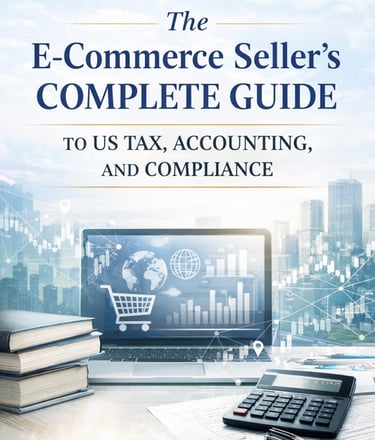
E-commerce is not just another small business model. It is a multi-state, multi-platform, multi-tax system that scales faster than most sellers realise.
The moment you sell across state lines, use Amazon FBA, operate through multiple platforms, or cross economic nexus thresholds, you are operating inside overlapping tax regimes. Sales tax, income tax, self-employment tax, payroll, state registration, inventory accounting, and cross-border exposure all move at different speeds — and none of them cancel each other out.
This guide is structured as a full compliance architecture, not a surface checklist.
Below is what each section covers.


Part 1 — The Big Picture
This section establishes the foundation.
It explains:
• Why e-commerce creates more tax exposure than most traditional businesses
• The three completely separate tax systems sellers must manage
• How the Wayfair decision changed multi-state compliance permanently
• Why marketplace collection does not equal full compliance
• Why growth increases risk if structure and systems are not aligned
This part frames the problem correctly before diving into technical detail.
Part 2 — Entity Structure
This section addresses legal structure and tax positioning.
It covers:
• Sole proprietor risk and why “doing nothing” is still a decision
• LLC protection and operating discipline
• Single-member vs multi-member implications
• S-Corp election mechanics and salary requirements
• When C-Corp structure becomes strategic
• State formation realities versus internet myths
• Registered agent requirements and EIN setup
• Revenue thresholds that justify structural changes
Entity decisions determine liability protection, tax efficiency, and exit flexibility. This section ensures the foundation is built correctly.
Part 3 — Sales Tax
This is the operational core.
It covers:
• Physical nexus and economic nexus triggers
• Marketplace facilitator laws and their limits
• FBA inventory creating multi-state exposure
• Product taxability variations by state
• Registration and filing mechanics
• Destination vs origin rules
• Voluntary Disclosure Agreements for back exposure
• Automation tools and where they fail
Sales tax is the most common and most misunderstood risk area for online sellers. This section breaks it down state by state and platform by platform.
Part 4 — Income Tax
This section explains how profit is actually taxed.
It covers:
• Schedule C vs S-Corp vs C-Corp treatment
• Self-employment tax mechanics
• COGS and inventory accounting
• Section 263A capitalization rules
• QBI deduction eligibility
• Depreciation strategies
• State income tax nexus differences
• Quarterly estimates and penalty avoidance
Income tax is not about what platforms report — it is about what your accounting system produces. This section shows how to align both.
Part 5 — Platform-Specific Issues
This section translates theory into platform reality.
It covers:
• Amazon 1099-K reconciliation
• Settlement report interpretation
• Shopify configuration risks
• Etsy, eBay, Walmart Marketplace nuances
• TikTok Shop emerging exposure
• Multi-platform aggregation rules
• Dropshipping seller-of-record complexity
Platform reporting rarely matches taxable income without structured accounting. This section closes that gap.
Part 6 — Bookkeeping and Accounting Architecture
This section focuses on systems.
It covers:
• Why generic bookkeeping fails for e-commerce
• Cash vs accrual method decision points
• Inventory profit distortion risks
• Settlement reconciliation methodology
• Multi-currency treatment
• Chart of accounts design
• Tool integration and automation
• Monthly close discipline
Without correct accounting architecture, tax compliance becomes reactive and unreliable.
Part 7 — Payroll and Hiring
This section addresses operational expansion.
It covers:
• Payroll obligations triggered by S-Corp status
• Employee vs contractor classification
• Federal and state payroll requirements
• Overseas contractors
• PEO and payroll platform selection
Hiring changes compliance exposure immediately. This section outlines what must be implemented before growth compounds errors.
Part 8 — International Sellers Selling Into the US
This is the structural differentiator.
It covers:
• When non-US sellers have US tax exposure
• Effectively Connected Income
• Form 5472 requirements
• ITIN vs EIN distinctions
• US banking realities
• Treaty considerations
• Managing US tax alongside home-country VAT
International sellers face dual-system compliance. This section addresses both sides of the equation.
Part 9 — Sales Tax Automation
This section examines tools realistically.
It covers:
• Why manual compliance fails at scale
• TaxJar, Avalara, and Sovos comparison
• Platform integration
• Automation blind spots
• Total compliance cost at different revenue levels
Technology reduces friction but does not remove judgment.
Part 10 — Catching Up
This section addresses remediation.
It covers:
• Back sales tax exposure
• Statute of limitations mechanics
• Voluntary Disclosure Agreements
• Multistate Tax Commission programs
• Back income tax filings
• Streamlined procedures for foreign sellers
Fixing the past correctly is often less expensive than sellers fear — but only when handled strategically.
Part 11 — Scaling and Exit Planning
This section addresses advanced positioning.
It covers:
• Revenue thresholds that trigger structural change
• Multi-state income tax strategy
• Transfer pricing considerations
• Capital raising and equity structure
• Asset vs stock sale tax outcomes
• Section 1202 Qualified Small Business Stock eligibility
• Succession planning
Tax strategy becomes more important as valuation increases.
Part 12 — Annual Compliance Calendar
This section consolidates deadlines.
It covers:
• Estimated tax payments
• Sales tax filing cycles
• Payroll deposits
• State annual reports
• Inventory year-end procedures
• Strategic advisor engagement timing
Compliance discipline reduces audit risk and cash flow shocks.
Part 13 — Working With Professionals
This section explains advisory standards.
It covers:
• What a specialist e-commerce advisor does differently
• Why general bookkeeping is insufficient
• Enrolled Agent vs CPA distinctions
• How to evaluate advisors
• Cost expectations at different revenue levels
Professional support becomes economically rational long before most sellers realise it.


About Antravia Advisory
Antravia Advisory is a US-based tax and accounting advisory firm headquartered in Winter Park, Florida, operating nationally and internationally.
We advise international businesses entering the United States and complex US companies operating across multiple states, entities, and revenue structures. Our work spans advanced tax strategy, multi-state sales tax oversight, cross-border structuring, and high-level accounting architecture for e-commerce brands, subscription and SaaS businesses, platform-based models, and multi-entity groups.
We work with founders and leadership teams who require technical precision, structural clarity, and financial frameworks built for scale, capital events, and long-term resilience.


The E-Commerce Seller’s Complete Guide to US Tax, Accounting, and Compliance
Part 1 — The Big Picture
Part 2 — Entity Structure
Part 3 — Sales Tax
Part 4 — Income Tax
Part 5 — Platform-Specific Issues
Part 6 — Bookkeeping and Accounting Architecture
Part 7 — Payroll and Hiring
Part 8 — International Sellers Selling Into the US
Part 9 — Sales Tax Automation
Part 10 — Catching Up
Part 11 — Scaling and Exit Planning
Part 12 — Annual Compliance Calendar
Part 13 — Working With Professionals
Disclaimer:
Content published by Antravia is provided for informational purposes only and reflects research, industry analysis, and our professional perspective. It does not constitute legal, tax, or accounting advice. Regulations vary by jurisdiction, and individual circumstances differ. Readers should seek advice from a qualified professional before making decisions that could affect their business.
See also our Disclaimer page
Antravia Advisory
Accounting built for complexity
Not legal advice, always verify with your Accountant
Email:
Contact us:
© 2025. All rights reserved. | Disclaimer | Privacy Policy | Terms of Use |
contact@antravia.com
Antravia LLC
941 W Morse Blvd suite 100
Winter Park
Florida
32789